Blog
Motivation behind 8 Minutes Club
13 min

There are some ideas that stay with you long after you stop working on them.
For me, the idea behind 8 Minutes Club started almost ten years ago.
I didn't know what to call it then. I didn't know what technology would eventually make it possible. I certainly didn't imagine that AI would become powerful enough to help solve the problem I was thinking about.
But I knew there was a problem.
People were increasingly forming opinions without genuinely understanding the other side.
And I had experienced that problem firsthand.
It started with JNU in 2016
In 2016, the protests at Jawaharlal Nehru University became one of the most polarizing political and social debates in India.
Names like Kanhaiya Kumar, Umar Khalid and Shehla Rashid became part of national political discourse. Social media was flooded with arguments, counterarguments, accusations and competing versions of what had actually happened.
I found myself engaging in several debates with students from JNU.
What struck me wasn't necessarily that we disagreed.
Disagreement is healthy.
What bothered me was how difficult it sometimes seemed to have a genuine conversation across ideological or professional boundaries.
I came from a technology background. And in some of those conversations, I felt that people from technology and business were viewed through a particular ideological lens—as capitalists, beneficiaries of the system, or people who therefore couldn't genuinely understand larger social and political questions.
There were moments when the attitude seemed to be:
You work in technology. What could you possibly understand about these issues?
I found that assumption fascinating.
Not because I believed that engineers or technology professionals had some special claim to truth. We don't.
But the reverse assumption—that someone working in technology is inherently incapable of understanding social issues—was equally flawed.
It made me think about something much bigger:
What happens when people stop listening to arguments because they have already decided who is qualified to make them?
I didn't want to win the debate
My instinct wasn't to create another platform where one side could shout louder than the other.
I wanted to create something where someone could say:
"Here is my argument."
And someone else could respond:
"Here is another perspective. Consider this."
And both could be presented to the reader.
That became the seed of an idea.
I started building FactHunt.
FactHunt
The basic philosophy behind FactHunt was simple:
Don't just tell people what is true. Show them the arguments, the evidence and the competing perspectives so they can understand the issue themselves.
We covered a variety of stories and presented many of them almost like debates.
A story would have a particular claim or narrative.
Then we would look at:
- What supports the claim?
- What contradicts it?
- What context is missing?
- What do different sides say?
- What evidence exists?
- What questions remain unanswered?
We also allowed users to contribute their own perspectives.
In retrospect, I realize that I was trying to build a primitive version of what I now think of as a knowledge network.
I just didn't have the vocabulary for it.
Fact-checking wasn't enough
Very quickly, I realized something important.
Misinformation isn't simply a problem of false information.
It's also a problem of incomplete information.
A statement can be technically true while still creating a misleading impression because important context has been omitted.
Two people can look at the same event and focus on completely different facts.
And sometimes both of them can be right about the facts they are presenting.
The disagreement comes from:
- what they chose to include,
- what they chose to ignore,
- how they interpreted it,
- what assumptions they brought with them,
- and what evidence they considered credible.
That made me increasingly interested in the idea of presenting multiple perspectives rather than simply labeling something true or false.
I believed technology could solve this
Even back then, I had a strong feeling that technology could play a role in solving this problem.
I thought about things that, at the time, were still relatively immature:
- artificial intelligence
- recommendation systems
- knowledge graphs
- decentralized systems
- blockchain
- crowdsourced verification
I didn't know exactly how they would fit together.
But I believed that eventually technology could help create something fundamentally different from traditional social media:
A system that doesn't just optimize for what you already believe.
A system that actively helps you discover what you might be missing.
FactHunt actually grew
FactHunt wasn't just an experiment that nobody used.
At one point, the platform reached around 10,000 daily active users and more than 15,000 followers on Twitter.
That experience taught me something extremely valuable.
There was an audience for this.
People were willing to read.
People were willing to debate.
People were willing to challenge each other.
And people were interested in understanding controversial issues—when the information was presented in a way that made the conversation accessible.
But eventually, for personal reasons, I stopped working on FactHunt.
The brand slowly disappeared.
The idea didn't.
Ten years later
Fast forward almost ten years.
Technology has changed dramatically.
The internet has changed.
Social media has changed.
And perhaps most importantly, AI has changed.
Today, an AI agent can search thousands of pages, identify competing arguments, summarize research, trace claims to sources and organize information in seconds.
The technology I imagined might eventually exist in 2016 is suddenly much closer to reality.
But something else happened during those ten years.
The information environment became even more fragmented.
Are we creating a generation that doesn't go deep?
Recent political and social events—including the CJP-led protest that caught my attention—made me start thinking about this problem again.
What concerned me wasn't simply that young people held opinions that I disagreed with.
Young people should disagree.
They should challenge established beliefs.
They should question institutions.
They should question people like me.
That's how society progresses.
What worried me was something different:
How many of those opinions are actually the result of understanding an issue deeply?
How many come from:
- a 30-second Instagram Reel,
- a WhatsApp forward,
- a viral tweet,
- a YouTube clip,
- an influencer's interpretation,
- or an algorithm repeatedly showing someone the same worldview?
And this isn't just a Gen Z problem.
It's a human problem.
I am not immune to it.
Neither are you.
The algorithms that surround us are exceptionally good at showing us things we are likely to engage with.
And what are we most likely to engage with?
Often, things that confirm what we already believe.
The echo chamber problem
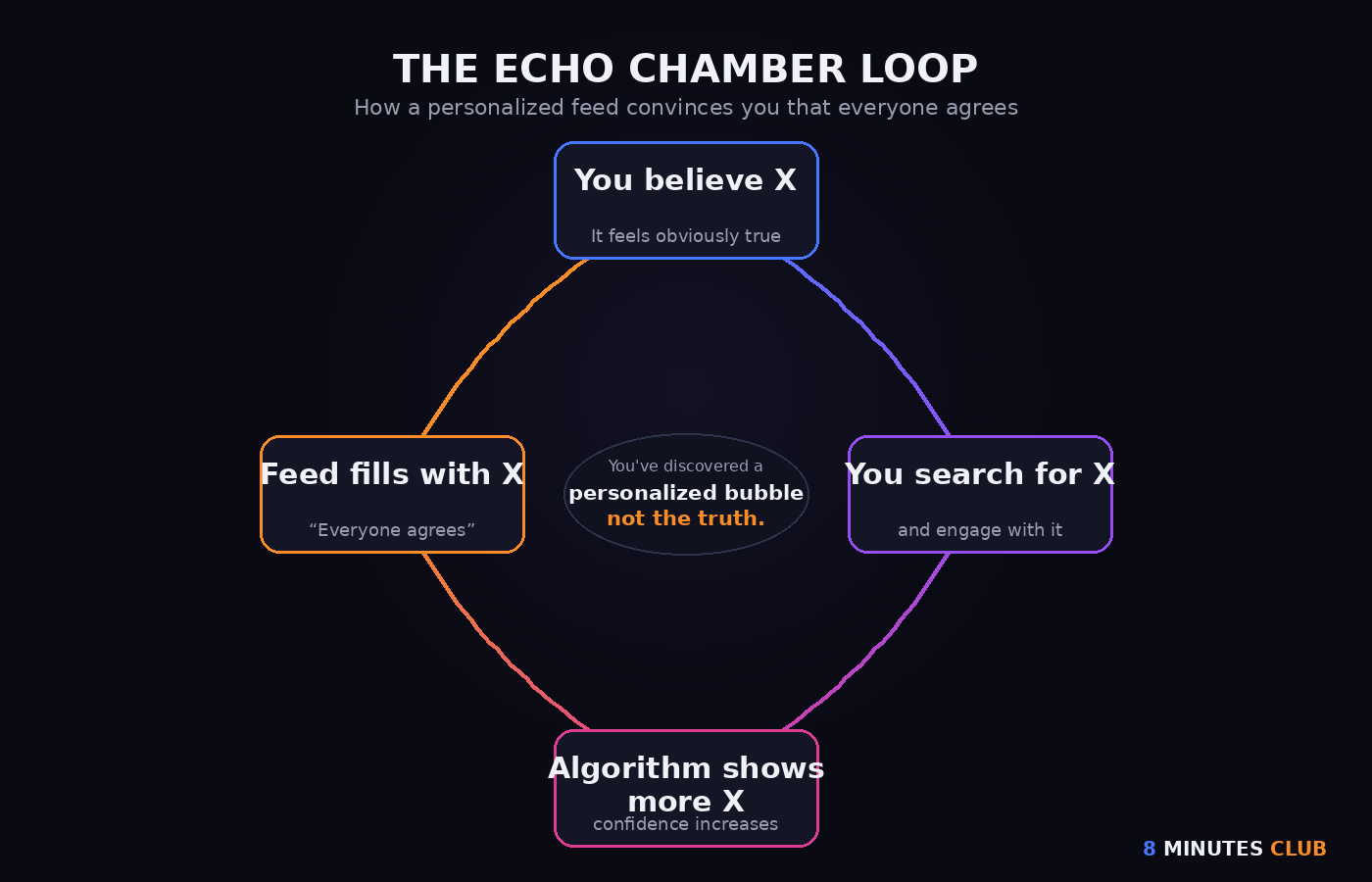
Imagine that you believe:
X is true.
You search for X.
The algorithm learns that you like X.
It shows you more X.
You engage with X.
The algorithm becomes even more confident.
Eventually your feed looks like:
X
X
X
X
X
And you begin to conclude:
"Everyone knows X is true."
But you haven't necessarily discovered the truth.
You've discovered a personalized information environment that agrees with you.
This is one of the fundamental problems I want to address.
What if social media worked differently?
What if, instead of asking:
"What content will keep this person engaged?"
a platform asked:
"What information would help this person understand this topic better?"
What if, when you read:
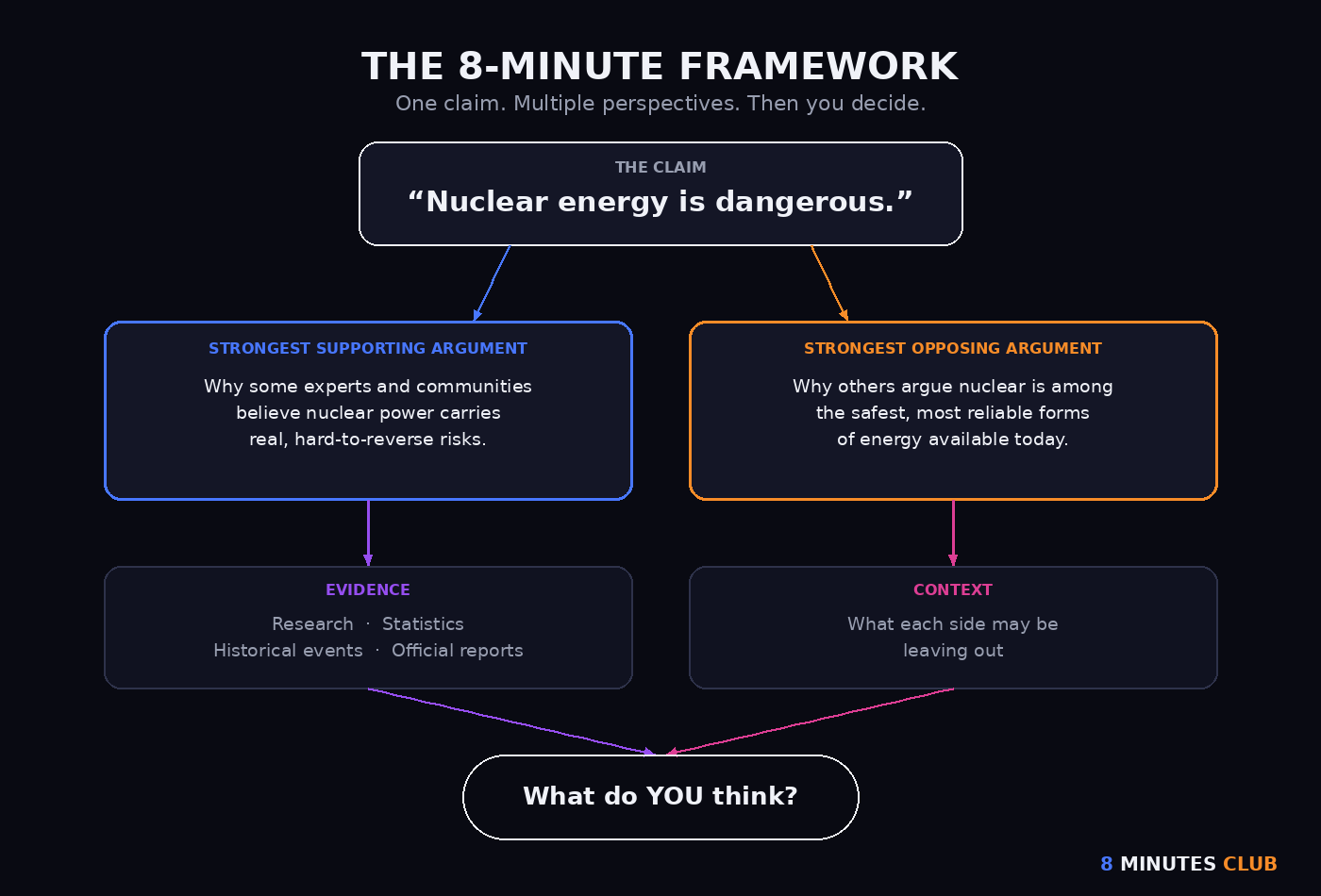
"Nuclear energy is dangerous."
the platform didn't immediately show you ten more posts agreeing with you?
Instead, it showed:
The claim
Nuclear energy is dangerous.
Strongest supporting argument
Why some experts and communities believe this.
Strongest opposing argument
Why others argue that nuclear energy is among the safest and most reliable forms of energy.
Evidence
Research.
Statistics.
Historical events.
Official reports.
Context
What each side may be leaving out.
And then it simply asked:
What do you think?
That is the experience I want to build.
This is where 8 Minutes Club came from
The name came from a simple idea:
You don't need to become an expert on everything.
You probably don't have the time.
Nobody does.
But perhaps you can spend eight minutes understanding a topic before forming a strong opinion about it.
Eight minutes isn't supposed to be a scientifically perfect amount of time.
It's a behavioral constraint.
It says:
You don't have to spend three hours researching every issue.
But before you repost something, argue about it, vote on it, or confidently tell someone they're wrong—spend eight minutes understanding the issue.
Eight minutes.
One topic.
Multiple perspectives.
Then form your own opinion.
The product isn't about telling you what to believe
This distinction is fundamental.
I don't want 8 Minutes Club to become another platform that says:
"Here is the correct opinion."
That would simply replace one authority with another.
Instead, I want it to say:
"Here is the claim."
"Here are the strongest arguments supporting it."
"Here are the strongest arguments challenging it."
"Here is the evidence."
"Here is what remains uncertain."
Now decide for yourself.
The goal isn't agreement.
The goal is better-informed disagreement.
From FactHunt to Prism

This is where today's technology changes the equation.
In 2016, much of this work had to be done manually.
Someone had to:
- find articles,
- read them,
- identify claims,
- research counterarguments,
- compare sources,
- write summaries,
- update the story.
That doesn't scale.
Today, AI agents can help.
That's why I'm building Prism.
Prism is an AI research agent for 8 Minutes Club.
Give Prism a claim and it can search the web to discover:
- supporting perspectives,
- opposing perspectives,
- relevant evidence,
- expert opinions,
- research,
- historical context,
- and perspectives that may otherwise be missed.
But there is an important principle:
Prism doesn't decide what you should believe.
It expands the search space.
Humans still evaluate.
Humans still disagree.
Humans still decide.
From debates to a Knowledge Graph of Humanity
The more I thought about this, the more I realized that 8 Minutes Club could be much bigger than a social network.
Every debate contains knowledge.

Consider a simple claim:
Remote work increases productivity.
That claim connects to thousands of other pieces of information:
- productivity
- employee satisfaction
- management
- collaboration
- software engineering
- geography
- commuting
- office costs
- company culture
- economic productivity
And each of those topics contains competing claims, evidence, sources and perspectives.
So instead of thinking about content as isolated posts, I started thinking about relationships between knowledge.
A claim connects to an argument.
An argument connects to evidence.
Evidence connects to sources.
Sources connect to other claims.
Claims support or contradict other claims.
Over time, these relationships form something much more interesting:
A knowledge graph built collectively by humanity.
Not a graph where one organization decides what humanity should know.
A graph where people can contribute claims, perspectives, evidence, corrections and context—and where those relationships remain visible.
The long-term vision
8 Minutes Club is the first step.
Prism is the first AI agent.
And eventually, the underlying knowledge could become something much larger.
That is the thinking behind the Open Knowledge Protocol (OKP).
The idea is to create an open framework through which knowledge can be represented as structured objects containing:
- claims,
- perspectives,
- evidence,
- sources,
- relationships,
- provenance,
- disagreements,
- and changes over time.
The long-term ambition is not simply to build another website.
It is to explore whether we can build an open knowledge layer for the internet.
Why now?
In 2016, I had the problem but not the technology.
Today, we have the technology—but the problem has become even more important.
AI has made it dramatically easier to generate information.
That is both exciting and dangerous.
We can now produce:
- articles,
- images,
- videos,
- opinions,
- summaries,
- arguments,
- and even seemingly authoritative explanations
at enormous scale.
The problem is no longer simply:
"How do we find information?"
Increasingly, the problem is:
"How do we navigate an overwhelming amount of information and understand what different people believe, why they believe it, and what evidence supports those beliefs?"
I think that's a problem worth working on.
This isn't about left or right
It would be easy to interpret the story of FactHunt through the political events that inspired it.
But that would miss the point.
The problem exists everywhere.
It exists between:
- left and right,
- liberals and conservatives,
- capitalists and socialists,
- religious and secular communities,
- scientists and skeptics,
- urban and rural communities,
- different generations,
- different countries,
- and even different groups within the same family.
And sometimes the two sides aren't even left and right.
Sometimes there are five or ten legitimate perspectives.
That's why I don't want 8 Minutes Club to become a "both sides" machine that assumes every issue has exactly two equally valid positions.
The goal is perspective diversity.
Sometimes there are two sides.
Sometimes there are many.
Sometimes one position has overwhelming evidence.
Sometimes the evidence is genuinely uncertain.
The platform should help users understand that distinction.
What I hope 8 Minutes Club becomes
I don't want people to open 8 Minutes Club and ask:
"What should I think today?"
I want them to ask:
"What am I missing?"
That's a very different mindset.
I want someone to encounter an argument they strongly disagree with and think:
"I still disagree—but I understand why someone might believe this."
That's progress.
I want someone to discover that their own position was based on incomplete information and be comfortable changing it.
That's progress too.
And I want disagreement to become less about defeating the other person and more about improving our collective understanding.
Eight minutes is just the beginning
The ultimate goal isn't eight minutes.
The ultimate goal is better thinking.
Eight minutes is simply an invitation.
An invitation to pause before reacting.
To look beyond the feed.
To encounter an argument you wouldn't have chosen yourself.
To read something that challenges your assumptions.
To examine the evidence.
And then:
form your own opinion.
That is why I'm building 8 Minutes Club.
Because I don't think the answer to misinformation is simply more information.
I think we need better ways to organize, challenge, contextualize and connect information.
And perhaps, if we get it right, we can build something bigger than another social platform.
We can start building a Knowledge Graph of Humanity—one claim, one perspective, one piece of evidence, and one informed mind at a time.